|
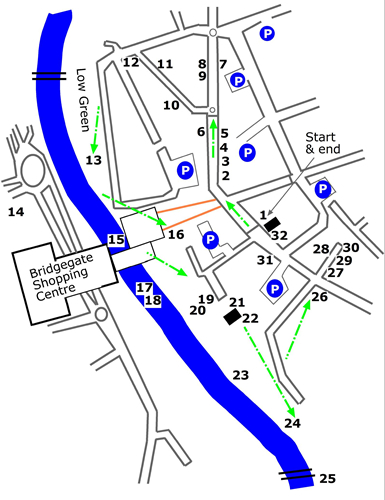
Walking route: Start at the Town House. Look
across the road at the unusual gable end above the solicitor's office.
This is the oldest building on the High Street. (Details to follow.)
Cross the road to view the Town House exterior.
back to top
1: Town House (podcast-ready text,
including the War Memorial)
New buildings are usually controversial, and Irvine Town House was no
exception. In 1860 the Provost, Thomas Campbell, was so against this large
Italian style edifice that he boycotted the ceremony for laying the foundation
stone.
For a cost of £4,000, the Town House provided the Royal Burgh with
a new council chamber and court house. No prison cells for local miscreants
were required – not because Irvine didn’t need any, but because
the new Police Station contained some. Above the Town House is a handsome
clock and belfry, terminating in an octagonal steeple.
So, what did Provost Campbell unsuccessfully propose? He wanted the old
Tolbooth to be renovated. The old Tolbooth stood in the middle of this
wide High Street, with its council chamber, court room, prison cells,
and ground floor space for three shops and the town fire engine Although
historic, it had become seriously dilapidated. Originally constructed
in 1386, it had become a fine two-storey building with a steeple, and
had received major renovation in 1672 and 1745. The options were to renovate
or replace. Provost Campbell lost the argument, and Irvine lost its old
Tolbooth – but gained a grand Town House, opened in 1862. One item
from the old Tolbooth was brought over to the new building – look
to the top of the steeple and you will see the weathervane in the shape
of a sloop, recalling Irvine’s past glory as a major port in the
days before the dredging of the River Clyde.
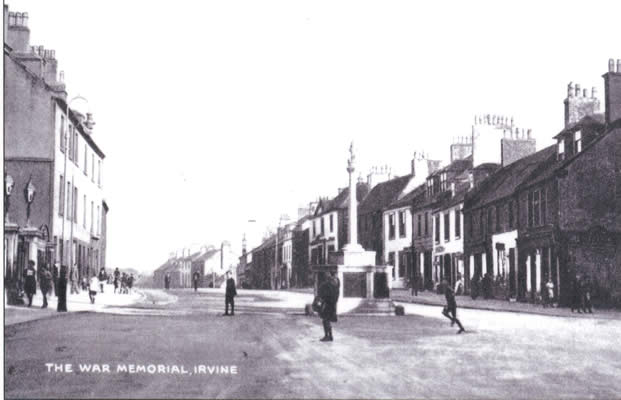
In the roadway, you will see a circle marking where the market cross
once stood. A market cross, as local historian McJannet remarked, was
“the focus of the burgh, the meeting place of the burgesses, the
spot at which proclamations were made, and the scene of public rejoicings
of all kinds”. The cross no longer exists, but the War Memorial
to the right suggests what it may have looked like. That War Memorial,
placed in front of the Town House after the First World War, was hit by
a runaway truck in c.1951 and re-erected in its current position.
The above is a draft podcast text. Here we can add that the anti-militaristic
feeling of the 1920s/1930s occasioned the removal, in 1929, of two old
cannon from their place in front of the Town House (as well as the removal,
from the parish churchyard, of two captured German guns).
Walking route: Going left (north) and crossing
to the other side of the High St., pass The Carrick hostelry (formerly
the Eglinton Arms, dating back to 1719) and look out for the first of
the signs about historic closes. The pavement artwork, lifted during paving
reinstatement in 2013, will be relocated in due course (description below).
back to top
2: Purdie's Close
One of the many narrow closes situated between the overcrowded tenements,
it led past the old bowling green to East Road. This is the Close where
Purdom, the Master Baker, carried out his business.
back to top
3: Smiddy Close
This is the Close where the blacksmiths made horseshoes and fitted them
onto the horses.
back to top
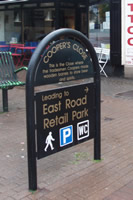
4: Coopers Close
This is the Close where the tradesmen Coopers made wooden barrels to
store beers and spirits.
back to top
5: Pawkie's Close
Another old close, named after Provost Pawkie, the main character in
John Galt's novel "The Provost" (1822), based on Bailie Fullarton
(a councillor for 42 years, 1790-1832). John Galt lived across the street
from here.
back to top
Walking route: At this point, cross the street
at the Bank of Scotland before returning to the right hand side.
6: John Galt's House (site of)
A plaque to the right of the door of the Bank of Scotland commemorates
that the birthplace of John Galt, novelist, stood here. John Galt was
one of the first two Honorary Members of Irvine Burns Club, in 1828, as
described elsewhere
on this site. The plaque was created by Ayrshire artist, Robert Bryden,
R.A.; it reads: “John Galt – born here 1779 – died at
Greenock 1859” and is signed “R Bryden fecit 1903”.
Walking route: Continue on the right, past the
Library, until you reach a fine Edwardian red sandstone building with
Provost's lamps outside it (at a bus stop!).
back to top
7: Irvine Burns Museum
Opening hours:
April to September - Mon., Wed., Fri., Sat. 2.30-4.30 pm
October to March - Saturdays only - 2.30-4.30 pm
Admission: free
Exhibits: Audio-visual on Burns in Irvine (11 minutes)
Also manuscripts, honorary members' letters, stained glass window, sculpture,
and much more.
For more information, visit www.irvineburnsclub.org
Walking route: Cross the road at
the Burns Museum.
back to top
8: West Port (site of)
Though there are no visible traces, here once stood one of the town ports,
or gateways, the West Port, long ago demolished to widen
the road.
back to top
9: Elephant Inn (site of) & Bachelors' Walk
Universty of Glasgow classes once met here in Eglinton
Street. In 1626, Irvine Burgh Council had given £100 towards the
redevelopment of Glasgow University. In the same year, a native of Irvine
became its Principal, and the ministers of Irvine and Kilwinning were,
in 1642, appointed professors of divinity. No wonder, then, that when
smallpox struck Glasgow in 1645-47, the university was evacuated
to Irvine (and to Pasley).
Where exactly classes were taught and staff were accommodated is not
clear. The evidence (quoted by Coutts, 1909) is that bursars were boarded
from the start, and the principal and professors soon afterwards, and
that maltman John Graham was paid for "furnisching of the house".
The site was later occupied by the Elephant Inn, of some notoriety, which,
in its turn, after years of dereliction, was replaced by two council houses
after WWII. While McJannet's 1938 History of Irvine states that "tradition
records that many of the students resided in the Elephant Inn", and
castigates its impending destruction as an act of 'ignorance', Strawhorn's
1985 History of Irvine records that classes were conducted in a malt barn.
The building referred to in the University records, whatever it was, was
not an inn - the Inn will date to after the University use of the premises.
The Bachelors' Walk was
the name given to this part of the street many years ago. The name arose
from its popularity with young men strolling to impress.
Walking route: Now continue, facing the town
centre, for a short distance. When you meet Seagate, turn right down the
cobbled street.
back to top
10: Seagate
The street leading to the seaport when Irvine was first established.
It was refurbished by Irvine Development Corporation in 1994.
back to top
11: Seagate Castle (podcast-ready
text below)
 There
was a castle in Irvine in 1184, in the form of a wooden tower on a 'motte',
the location of which is not known. The first stone Seagate Castle probably
dates to the 1360s, constructed by Sir Hew of Eglinton. The greater part
of the third and still surviving castle, incorporating the 14th century
square stone tower, was built by Hugh, 3rd Earl of Eglinton (1564-85),
possibly in 1565, after his marriage to Margaret Drummond. What
follows is a draft podcast text. There
was a castle in Irvine in 1184, in the form of a wooden tower on a 'motte',
the location of which is not known. The first stone Seagate Castle probably
dates to the 1360s, constructed by Sir Hew of Eglinton. The greater part
of the third and still surviving castle, incorporating the 14th century
square stone tower, was built by Hugh, 3rd Earl of Eglinton (1564-85),
possibly in 1565, after his marriage to Margaret Drummond. What
follows is a draft podcast text.
Firstly, let us explain the name Seagate. It is not a gate. The old town
gateways were called ‘ports’ from the Latin word ‘porta’,
so if you buy a refreshment in Irvine’s Porthead Tavern, you are
on the site of one of Irvine’s old gateways. The word ‘gate’
is not a gateway, but a street because you go along it, so Sea-gate means
the street leading to the sea. The sea was once much nearer to the town
than it is today.
The first stone Seagate castle probably dated to the 1360s, constructed
by Sir Hew of Eglinton, the local laird. Part of its 14th century stone
tower still remains in the north-west corner of the present – third
– castle, constructed in the Scottish Renaissance style, possibly
in 1565, by Hugh, the 3rd Earl of Eglinton, after his marriage to Margaret
Drummond. On two bosses in the vaulting of the entrance passageway are
the initials of the married couple – HM and MD - and the coast of
arms of the Montgomerie and Drummond families. Its ground floor contains
kitchen and guard chamber, with two vaults and small windows. The first
floor contains two large apartments and a great hall, with large windows.
Another floor, now gone, had other chambers.
There is fierce controversy over whether Mary Queen of Scots, that feisty
young monarch, stayed the night here in 1563. Some say she did, but the
records state explicitly that she stayed at Eglinton on 1st August. Perhaps
she paid a fleeting visit to a castle under reconstruction at the time.
Seagate Castle is Irvine’s oldest building, but looking at it today,
it is difficult to believe that it was once referred to as a ‘Palace’.
It had ceased to be occupied by the 1700s. The 10th Earl removed the roof
to provide timbers for a church in Ardrossan. It was ruinous by 1760.
It became a haunt for smugglers and a quarry for building stone. Debris
was removed in 1883. It is unfortunate that safety concerns now forbid
public access.
Walking route: At the end of the
road, turn left to face the river.
back to top
12: The Black Man (statue)
David Boyle, born at the Parterre House in Irvine in 1772, became an
advocate in 1793, then Solicitor General and MP for Ayrshire 1807-11,
was Lord Justice Clerk 1811-41 and Lord Justice General and President
of the Court of Session 1841-52; he died in 1853. The statue, sculpted
by Sir John Steele, was erected in 1867 outside his birthplace
(the Parterre) opposite the Town House, and was moved to its present location
at Seagatefoot in 1929.
Walking route: Follow the road round to the
left, and at the first opportunity, join the path through what is named
the Low Green. Face the shopping centre and make for the Trades memorial
in the middle of the grassed area.
(Those with plenty of time can consider
a detour north under the road bridge to visit the fine 1896 Burns Statue,
or at least to go far enough to view it in its position, facing Alloway,
high above the river. Information about it appears below.)
back to top
13: Trades Pillar
This eight-sided pillar was erected in 1996 on the 350th anniversary
of the granting of a common seal to the seven trade guilds of medieval
Irvine in 1646.
The seven trades of Irvine are, in traditional order
of precedence:
The Hammermen - first recorded meeting 1646, annually
thereafter without a break - included smiths, pewterers, coppersmiths,
goldsmiths, armourers, lorimers, cutlers, gunsmiths and (strangely) saddlers.
The Weavers - who worked in wool, linen, cotton (from
1780) and muslin -their minutes go back to the 1700s.
The Tailors - their minutes going back only to 1889,
as earlier records were lost or destroyed.
The Cordiners - "shoemakers and other wortkers in
leather"
The Wrights and Squaremen - the only craft which still
requires applicants to make an "assay piece" to gain entry.
The Skinners - those who prepared raw skins into hides
which could then be used by cordiners and others - after the demise of
such workers, and their craft guild, it was reconstituted in 1920.
The Coopers - makers of barrels - for ales, for salted
beef, for fresh water on voyages, for gunpowder, for anything.
For more on the Trades Guilds, see www.irvinetrades.org
back to top
14: Friars' Croft (site of Priory) & church
spires
Looking across the river from the Trades Pillar, you see the Council
headquarters block ('Cunninghame House') It is on the site of a religious
house, founded in the mid 14th century, when one of the Fullarton
family gave land to the Carmelite Friars (the White Friars). Their priory
was one of ten Carmelite houses in Scotland. The church properties were
feued by the last prior in 1558, and demolition of the buildings
must have soon followed, as nothing remained by 1600. It had been in existence
for about 200 years.
Also from the Trades Pillar, four church
spires are visible:
From left (east) to right (west):
(above you to left) the Mure Church, built in 1849 as the
Irvine Free Church - in 1900 it became the Mure United Free Church).
Trinity Church, opened in 1863 (more below).
Fullarton Free Church, built in 1844, under the seceding
minister Rev. Wilson).
Fullarton Parish Church, opened in 1838 as the
first parish church for the Fullarton part of Irvine, which at that time
was part of the Parish of Dundonald.
back to top
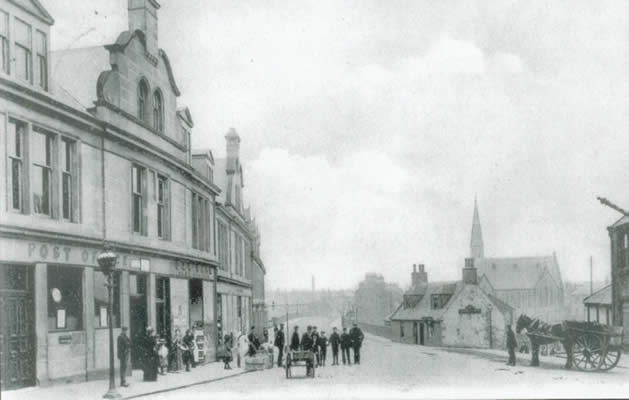
15: Irvine Bridge (site of)
Also while standing by the Trades Pillar, you can recall the road bridge
demolished in the 1970s.
Though Ayr had a bridge from 1236, Irvine seems not to have, and historian
John Strawhorn ('The History of Irvine', John Donald Publishers Ltd, 1985)
suggests the first timber structure may have been built in the 14th
century, especially as the burgesses could build a tolbooth at that
time (1386).
The first stone bridge may have been about 1500 (the first mention
of Bridgegate is in 1506), and certainly before 1533. In 1578, the whole
of Ayrshire was required to contribute to its repair. In 1589 and afterwards
the burgh levied tolls on those crossing it, for repairing the 'decayit
brig'. A few years later, Timothy Pont mentioned Irvine's 'fair stone
bridge'. Transporting coal across the bridge was prohibited in 1695, after
which carts had to use a nearby ford.
Increasing trade led to a new bridge being built in 1748-53 (though
only 11 feet wide, as wheeled vehicles were still uncommon), with four
semi-circular arches each of forty feet span, at a cost of £350.
 The council obtained parliamentary consent for widening the bridge
in 1826, and this was done, to a width of 25 feet; the pontage tolls
had paid for the improvement, and were removed by 1850.
The council obtained parliamentary consent for widening the bridge
in 1826, and this was done, to a width of 25 feet; the pontage tolls
had paid for the improvement, and were removed by 1850.
It was provided with iron latticework sides in 1887, widening it
to 38 ft.
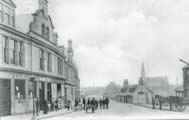
The bridge was closed on 10 June 1973, and demolished to make way
for a £5million shopping centre. Many residents of Irvine believe
that the shopping centre could, under less brutalist planners, have easily
incorporated the old bridge as an attractive and functional centre-piece.
(In the photo, the bridge is just beyond the people standing in the street.
To enlarge the picture, click it, then use the Back button to return.)
Walking route: Return to the road, keep to the
right, and take the concrete steps upwards to get to the refurbished plaza.
In the pavement (refurbished Nov/Dec 2013) you can follow a trail of important
dates in the story of Irvine <details to be added>. Here also you
can look up at Trinity Church.
back to top
16: Trinity Church
The Burgher Church was a Secession congregation meeting originally (from
about 1809) in Cotton Row (now Ballot Road). Their first minister (Rev
Alexander Campbell) presented Irvine Burns Club with the six original
manuscripts which his wife had inherited from a previous husband.
In 1847, the Burgher Church became, like the Relief Church, a United
Presbyterian Church. Under their second minister, the widely-known and
widely-respected Rev William Bruce Robertson, the church moved into Trinity
Church in 1863. The site had been gifted by a member
of the established church. There was a procession of magistrates and councillors
for the laying of the foundation stone.
Designed by T F Pilkington, it is cruciform in pattern, in Venetian Gothic
style, with variegated clour in the stone, and ornate throughout. Its
170-foot spire was completed in 1869 and shortened in 1870 when found
to be too heavy. In 1900, it became one of the four United Free churches
in the town. It ended its days as a church in 1966.
Walking route: Go into the shopping mall, keep
round to the left inside, and exit by the door onto the riverside path.
Stop and look at the river.
back to top
17: Puddlie Doodlie
According to tradition, the ford at this site prior to the building of
a bridge, the Puddleford, was the site of a skirmish between Wallace
and the English - there is no evidence that Wallace was
present, but the tradition gained credibility when repeated as fact in
the 1920s. An interesting possible origin of the name is as 'holy steps'
('pas de Dieu'), the stepping stones by which the monks from the Carmelite
Priory made their way to Church. Some of the stepping stones may have
come from the stones later removed, of which the Granny Stane (see next
item) is the last survivor. Use of the Puddleford by horses was prohibited
in 1836 to safeguard access to the Puddly Well, one of the public wells
all of which were repaired at about that time.
back to top
18: Grannie Stane (or Granny Stane)
Described as "one of Irvine's prehistoric puzzles", this boulder
may be one left behind from the Ice Age or the last remaining stone of
a stone circle - other stones were removed, by blasting, after the weir
was constructed in 1895, but popular protests saved this remaining stone.
Pleasure boats and bathing were introduced. The Grannie Stane is visible
when the water is low. It is unlikely to have gained its name from various
similar sounding Roman and Celtic deities.
Walking route: Now take the gentle slope
upwards to the left (the block paved path) to reach the Kirkgate (the
square in front of the church). On your left is The Old Manse, but it
was a manse for the minister of another church, not the incumbent at the
Old Parish. Walk towards the church, along the right of the street, stopping
at the last building before the churchyard.
The Old Manse belonged, in 1819 (Wood's Town Plan), to Mr Robert Rankin,
and was gifted in 1855 to the Free Church (who had built
their church at Hamilhill - it was renamed the Mure Church after receiving
support from the Misses Mure, two local well-off sisters) at the time
of their first minister, Rev. William Cousin (officiated 1850-1859).
back to top
19: Old Grammar School (site of) (1572
- 1750 - 1816, with some notes about its successors)
We know that the burgh had some responsibility for the upkeep of a school
in 1560. In 1572, a burgh school at Kirkgatehead was endowed; it
continued there until 1816. Throughout the 18th century the council consistently
sought to provide good schooling - they paid the schoolmaster the maximum
salary plus other fees and income, they employed extra members of staff,
they improved the old building in 1724, after 1750 they completely rebuilt
it, giving it two large rooms either side of a vestibule with a bell turret,
and they added an extension in 1783. John Galt attended
this school in 1787 for two years, and Edgar Allan Poe
in the school's last year (1815-16). After 1816, the building was occupied
by two free schools, by weavers, and from 1860 by the fire brigade; the
line of its gable end can be seen in the adjoining building. The burgh
school was replaced by an academy. The old building was demolished, by
then boarded up, in the 1960s prior to the extension of the church hall
(1968).
In 1813, the Town Council granted land at the north side of the town
for a new Academy. Thirty-one unemployed men were given work levelling
the Gallows knoll. The foundation stone was laid on 22nd April 1814, for
the building designed by David Hamilton of Glasgow, opened in July
1816, when it was decreed that there should be a "Holiday to
the Pupils in all time coming" each 10th December, the birthday of
Hugh, 12th Earl of Eglinton. In 1818 a royal charter was obtained by the
earl in his own right and as provost.
In 1900 this school was demolished and pupils were accommodated in halls
until the completion of a new building, costing £16,000, designed
by local architect John Armour. Now named Sovereign House, facing onto
the Northern Approach Road, it was officially opened in December 1901
by the Earl of Eglinton, great-grandson of the earl who had opened the
first Academy. It was proudly designated Irvine Royal Academy, a title
only occasionally used before, by those who remembered the royal grant
to the burgh school in 1572 and the royal charter of 1818.
back to top
20: Mortuary
On the path between the church hall and the churchyard is the bricked-up
Mortuary. It was set up in 1908, as one of several innovations organised
by the Town Council of that time. During the First World War, in about
1917, it was converted into a bath house for the Royal Engineers billeted
in the Church Hall. Later used as a store by the Church, it is now bricked
up.
back to top
21: Irvine Parish Church
Though the present building dates from 1773, a church was founded in
the early part of the 9th century by St Inan, who lived and laboured around
Irvine and Beith.
 Its
influence soon extended to the source of the River Irvine, and there are
records of gifts given by prominent families in the valley to endow missionaries
or Chaplaincies. One of them to "Officiate at the Chapel of the Virgin
Mary upon the bank of the water at Irvine." These messengers "carried
the gospel to villages within a radius of forty miles and even to the
'Island of Aran'." Its
influence soon extended to the source of the River Irvine, and there are
records of gifts given by prominent families in the valley to endow missionaries
or Chaplaincies. One of them to "Officiate at the Chapel of the Virgin
Mary upon the bank of the water at Irvine." These messengers "carried
the gospel to villages within a radius of forty miles and even to the
'Island of Aran'."
The first Church belonged to the Celtic Church and the second, built
early in the 12th Century, came under the famous Bull of Clement III declaring
"The Scottish Church is the peculiar daughter of the Roman Church
to which alone ('nullo mediante') she should show subjection".
Early mention of St. Mary's Church occurs in the agreement between the
Burgesses of Irvine and Brice the Earl of Eglintoun in 1205. It was built
"small and rude of freestone ashlar" and was cruciform in shape,
lit by narrow lancet windows turned with two arches. The oak panelling
exhibited in Irvine Burns Club is a relic of this early Church. The carving
is a fine example in the style of the Flemish Guild and the inscription,
in Greek, reads: "Blessed are they who hear the word of God and keep
it".
The Church was not large, and by the beginning of the 18th Century, reference
was made to the building as being too small for the growing population
of the Parish. The Reformation being now past, responsibility for a new
building lay with the Heritors of the Parish in consultation with the
Presbytery of Irvine. Heritors meetings were dominated by the two leading
Heritors - the Earl of Eglintoun and the Provost of Irvine. In their wisdom
they decided that their successors should be relieved of any such responsibility
in years to come and a large Church was decided upon to meet every future
contingency. Hence the name given 'The Big Kirk'.
The decision to build was made in 1770, with a seating capacity of 1770.
Linked? Could that be a seat for every year of Christian Witness in the
world?
There has been a long and close connection between Town and Gown, with
the Council, the Incorporated Trades, and Carters' Society. The Minister
was Chaplain of all three, and each still has its own seating accommodation.
Since the Reformation and until the end of the 18th Century, the Provost
was given his say in the appointment of the Minister, session clerk and
treasurer. There is however no record of the Kirk Session having anything
to do with the appointment of the Provost. The Church had the dominant
part to play in the education of the child with the encouragement and
financial support of the Town Council. Early records speak of the school
in the upper part of the Kirkgate, and later the guiding hand of the Church
in the building of the Royal Academy in 1806 and of the new Royal Academy
in 1902.
The windows of the church are described on another page.
Walking route: Go into the kirkyard. There are
many interesting and historic stones, though unfortunately no full catalogue
of them.
back to top
22: The Churchyard - some interesting headstones
(a map may be prepared)
a) The Rev. Charles Bannatyne (last minister of the
old church 1751-73)
b) The Rev. James Richmond (first minister of the present
church 1774-1804)
c) Provost John Glasgow (thrice Provost: 1742-44, 1746-48,
1750-52) (1764, the oldest legible stone)
d) Hugh Nisbet and spouse (1596)
e) Surgeon John Fletcher, a resurrectionist (1798-1830)
f) James Steedman, inventor of the screw propeller (1790-1865)
(see our special article, 'Who
Invented the Screw Propeller?', then use its Close X button to return
here)
g) Burgess John Thomson, a butcher (1688)
h) James Holmes and Elizabeth Turner (d.1918), maternal
great grandparents of Tony Benn, Labour politician
i) John Spiers, donor of the Burns Statue (d. 1899)
j) Jean Spirling (1790-1870), cousin of the novelist
John Galt
k) Provost Charles Hamilton (five times Provost: 1758-60,
1762-64, 1768-70, 1772-74, 1776-78, 1780-82) (d.1783), Provost at the
time Robert Burns lived in Irvine
l) Dr Charles Fleeming, who made several visits to the
ill Robert Burns
m) Mary Allan (1778-1851), 'aunt' to Edgar Allan Poe
in Irvine in 1815
n) Bailie Robert Fullarton (d.1835), the model for Provost
Pawkie in John Galt's novel 'The Provost'
o) Patrick Hunter (1732-1802), involved with the Buchanites
in Irvine
p) Bailie David Sillar (d. 1830), referred to by Burns
as 'Dainty Davie', first vice-president of Irvine Burns Club
q) Bailie Thomas Cumming (d. 1509), possibly the oldest
stone in the churchyard
r) Annie Mitchel (d. 1882, aged 7) after a tragic accident
s)<name unknown> (d. 1597), a stone from the previous
Kirk
t) Rev. Patrick Boyle (1717-1798), son of the 2nd Earl
of Glasgow
u) Duncan Macmillan (1770-1823), father of Daniel and
Alexander, who set up Macmillan Press in London, and great grandfather
of Harold Macmillan, Prime Minister 1957-63
v) Helen Miller (d.1827), one of the Belles of Mauchline
described by Robert Burns, and wife of Dr John Mackenzie, the doctor who
tended the poet's father and was first President of Irvine Burns Club
w) French Sailors / Irvine Seamen, a stone set up after a shipwreck
at Irvine harbour mouth in 1876
x) the martyrs James Blackwood and John McCoul, Covenanters
executed in 1666
y) A new headstone was laid in December 2008 to mark the grave of famous
newspaperman John Mennons, the founder and first editor
of "The Glasgow Herald", launched as the Glasgow Advertiser.
On selling the Advertiser, he set himself up as a coal-master; when that
venture failed, he moved to Irvine in 1814 in his late sixties, and, with
his six children, published the "Irvine and County of Ayr Miscellany"
in 1814-15 and "The Irvine Mercury" in 1815. He died in 1818.
The grave location was discovered by Irvine historian Billy Kerr. The
stone was paid for by the Glasgow Herald.
Walking route: Leaving by the back gate of the
kirkyard, there is an optional detour down the path on the right to the
river. If you wish to miss #23, go straight on to an open grassy area,
known as the Golffields, for #24.
back to top
23: St Inan's Well
St Inan's One of many wells in the burgh, this one was named after St
Inan, who came to Irvine in 839. For wells, see more information at no.
25 (Tanzie Well).
back to top
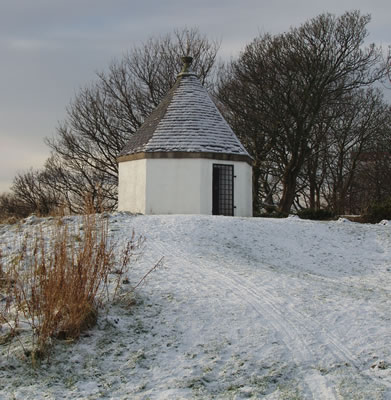
24: Powder House (Pouther Hoose)
(the first two paragraphs form a podcast-ready text)
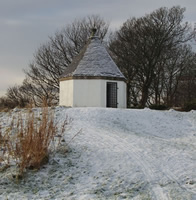 The
Powder House was probably first constructed about 1642 - King James VI
(d.1625) had instructed all Royal Burghs to provide 'Pouther Magazines'.
Records show that orders for large quantities of gunpowder were met in
1643, 1644 and 1646. Saltpetre was locally manufactured from deposits
in byres, stables and doocots, then stored in the safety of the Powder
House, for use by the military in the Royal Burgh of Irvine. In 1781,
following an unexecuted Franco-Spanish venture to invade the British mainland
in 1779 during the American Revolutionary War, plans were made to rebuild
it, and this was done by 1801, prior to the Napoleonic Wars (1803-15).
In 1880, the town council formally discontinued use of the Powder House.
Restoration was carried out in 1924, using slates saved by Provost R M
Hogg from the demolition of the old wash-house on the Golffields - a rescue
assisted by Rev. Henry Ranken of the Old Parish Church. It was again repaired
in 1961, and in 1992 it was again restored, this time by Irvine Common
Good Fund with assistance from Enterprise Ayrshire. The
Powder House was probably first constructed about 1642 - King James VI
(d.1625) had instructed all Royal Burghs to provide 'Pouther Magazines'.
Records show that orders for large quantities of gunpowder were met in
1643, 1644 and 1646. Saltpetre was locally manufactured from deposits
in byres, stables and doocots, then stored in the safety of the Powder
House, for use by the military in the Royal Burgh of Irvine. In 1781,
following an unexecuted Franco-Spanish venture to invade the British mainland
in 1779 during the American Revolutionary War, plans were made to rebuild
it, and this was done by 1801, prior to the Napoleonic Wars (1803-15).
In 1880, the town council formally discontinued use of the Powder House.
Restoration was carried out in 1924, using slates saved by Provost R M
Hogg from the demolition of the old wash-house on the Golffields - a rescue
assisted by Rev. Henry Ranken of the Old Parish Church. It was again repaired
in 1961, and in 1992 it was again restored, this time by Irvine Common
Good Fund with assistance from Enterprise Ayrshire.
On the adjoining slopes, the Powderhouse Brae, the Methodist missionary
George Whitefield preached to an assembly of 5000 in 1742, at the start
of the period of church secessions in Scotland. His preaching stimulated
an evangelical enthusiasm which ultimately led to the formation of the
Relief Church ten years later, in 1752. It initially met at the Golffields
and in 1773 opened its own church on West Road.
[The image is copyright to I J Dickson - click to enlarge it.]
In the 16th and 17th centuries, pigeon dung provided a major source
of saltpetre for the making of gunpowder. Until a better source of saltpetre
was found, it was strictly forbidden to put hard floors in dovecotes.
The saltpetre (potassium nitrate) was made by mixing the pigeon dung with
earth, lime and ashes – don’t do this at home (says the Herefordshire
Sites and Monuments Record). The saltpetre was then mixed with charcoal
and sulphur to produce gunpowder.
Walking route: There is an optional extra few
yards of walking to the spring issuing at this side of the green footbridge,
the site of the well, #25. If you wish to miss this, retrace your steps
to the back of the churchyard, then make your way up the street ('Kirk
Vennel') towards the main road, for #26.
back to top
25: Tanzie Well
The name is thought to be a corruption of St Anne's Well or St Inan's
Well. The area was always a place for washing clothes, and in 1749 (Strawhorn,
p.95) the Council erected a washing house 35' x 15' for washing and bleaching.
Other wells included one at Seagatehead (sunk in 1695) and one at Bridgegate
(sunk in 1722, using stones from the medieval church steeple, dismantled
in 1721 as being in dangerous condition), these two and an older one at
the Cross being converted into pump wells by the Council in 1740. There
were also wells at the Townhead (the Port well, named from the town gate
there, the Whiskey Well and the Tollbar Well), one at Kirkgatehead, one
at the Puddleford (the Black Well), others in Glasgow Vennel and Cotton
Row, further up the High Street (the Grip Well and the Townend Well),
further out at the Gallowsell, at Seagatefoot (the Slaughterhouse Well),
and the Chapel Well.
Walking route: Return to the back gate
of the churchyard and make your way up the street (Kirk Vennel) to the
main road.
There used to be a water pump on the verge here. A cast iron fluted column,
dating from about 1878, and manufactured by Glenfield & Kennedy Ltd,
Kilmarnock, it is the last surviving trace of Irvine's first piped water
supply. It has been renovated and is destined for the museum due to open
in 2015.
back to top
26: Townhead
The two old gates ('ports') at the north and (here, at Townhead) south
ends of the High Street were demolished in 1756 to improve the road through
the town. Not only did they narrow the road, but their condition was "ruinous".
Here, a house which encroached onto the street was also demolished. nevertheless,
the location, marked by the Porthead Tavern (a new building on its old
site; the old building was the home of Provost Hamilton, who befriended
Burns in 1781), is still a traditional halt in the annual Marymass parade.
In 1901 and in 1910, the proclamations of loyalty to the new monarchs
were read at the market cross, at the two ports, and at the harbour. The
barber's shop is on the site of the original manse for the Parish Church,
and the street name (Kirk Vennel) records the original narrow road to
the minister's glebe. A separate alley afforded the minister his own access
to the churchyard and his church.
Ex-Provost John Paterson, writing c.1892 (handwritten notes, p.62), mentioning
the well-known 17th c. minister David Dickson, recorded: “The manse
or house in which Dickson resided was situated at the Corner of the High
Street and Kirk Vennel; it was an antique plain two storey house, and
projected about ten feet further out into the High St than its successor,
the new house erected about 187- by Mr Jas. Frew. The Manse presented
a Gable end to the High St with a door & small windows facing down
the street. The Garden runs parallel with the Vennel, and a built up door
is still to be seen in the Wall, which would open into the passage leading
to the small Gate into the Kirkyard, but which is now included in the
Burial Ground.” (McJannet, p.146, mentions all the kirkyard-adjoining
gardens as having gates, as a practice accepted in Irvine, but dissuaded
in some other parishes.)
On p. 59, Paterson notes: “From 1630, Dickson’s Manse at
Irvine was said to be a refuge for many of the <outed(?)> Ministers
both from Scotland & Ireland from which latter country especially
they were pursued with relentless cruelty by the Bishops. Situated within
the Port of the Burgh where a guard was kept night and day by the Burghers
& having the goodwill of the Magistrates of Irvine as well as of the
Bailie of Cunninghame, The Earl of Eglinton, David Dickson was placed
in a vantage ground to defy the Bishops & even Royalty itself that
but few of the Clergy of the time enjoyed. The Guard at the Towns Port
had only to give the alarm and a thousand strong arms & willing hearts
would have surrounded the old Manse to defend the Minister.”
On p.61, Paterson’s notes record that Dickson was instrumental
in bringing College students to Irvine to study (he dates this to 1647,
but in fact it was 1645): “Dickson was about this time appointed
Professor of Divinity in Glasgow. His old liking for Irvine was well exemplified
by the fact that when the Pest or Plague raged in Glasgow in 1647 (it
had been in Irvine the year before & that Burgh was declared clean)
he, Dickson, brought out his students at the College to the sandy knowes
and sea breezes to pursue their studies.”
Walking route: Cross over to the cobbled street
opposite - Glasgow Vennel.
back to top
27: Glasgow Vennel
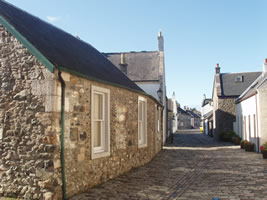 Known
in 1426 as Smithy Bar, its renaming by the end of the 1600s indicated
its importance as the main road to Glasgow (Bank Street was not constructed
till 1828). Robert Burns came here as a young farmer eager to learn the
trade of flax dressing, working in the Heckling Shop, and lodging a few
doors away. By the 1970s, the buildings were mostly unoccupied, and facing
almost certain demolition. The Heckling Shed, also known as the Heckling
Shop or House, was at the rear of no. 10. Known
in 1426 as Smithy Bar, its renaming by the end of the 1600s indicated
its importance as the main road to Glasgow (Bank Street was not constructed
till 1828). Robert Burns came here as a young farmer eager to learn the
trade of flax dressing, working in the Heckling Shop, and lodging a few
doors away. By the 1970s, the buildings were mostly unoccupied, and facing
almost certain demolition. The Heckling Shed, also known as the Heckling
Shop or House, was at the rear of no. 10.
Irvine Development Corporation’s Chief Architect Ian Downs persuaded
the authorities that restoration of this historic street was feasible.
In July 1980 the Corporation initiated discussions with Cunninghame District
Council with a view to setting up a joint project for restoration of the
Vennel. Other bodies such as Irvine Burns Club, the Scottish Tourist Board,
the National Trust for Scotland and the Clement Wilson Foundation (see
the page on Clement Wilson)
also declared their interest. This led to a Steering Committee, chaired
by Lord Ross of Marnock, a noted Burnsian. Restoration work began in 1981.
Early success prompted further phases. The third phase, funded jointly
by the Scottish Tourist Board and the Clement Wilson Foundation, included
restoration of the Heckling Shed and no. 10, with its unique curved frontage.
A fourth phase renovated the flat where Burns had resided. The Vennel
gained a Europa Nostra Award for conservation in 1984 – a street
of history bringing pleasure and pride to the modern town.
back to top
28: The Buchanites
Mrs Elspeth Buchan was invited to Irvine by a local minister, Rev Hugh
White, in 1783, and soon had enough followers to hold meetings - first
in a tent in White's Seagate garden, then in the Glasgow Vennel house
of Patrick Hunter, a prosperous lawyer and merchant. She and her followers
were twice driven out of Irvine by mobs, and twice returned, to be formally
banished by the Town Council in 1784.
The Buchanites were “waiting for the second coming of the Lord”
and believed “that they, alive, shall be changed and translated
into the clouds, to meet the Lord in the air, and to be ever with the
Lord”. For more details, see Strawhorn, pp.88-89 and Chalmer's
1812 Biographical Dictionary. Elspeth Buchan convinced White that
she was "the woman clothed with the sun" referred to
in the Book of Revelation 12:1 ("And a great sign appeared in heaven:
A woman clothed with the sun, and the moon under her feet, and on her
head a crown of twelve stars."). White assumed for himself the role
of "man child" referred to a little later in the same text.
back to top
29: Robert Burns Lodgings, 4 Glasgow Vennel
Burns lodged here in 1781. For his time in Irvine, see the page
in the Irvine Burns Club section.
back to top
30: The Heckling Shop, 10 Glasgow Vennel
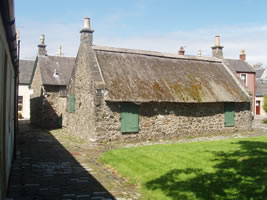 Where
Robert Burns worked - for this also, see the page
in the Irvine Burns Club section. Where
Robert Burns worked - for this also, see the page
in the Irvine Burns Club section.
After the buildings were renovated in the early 1980s, the front cottage
became, for some years from 1983, the home of the Ayrshire Writers and
Artists Society. The 1981 World Burns Conference delegates in 1981 were
shown the plans, also in model form, for the renovation.
Walking route: Return to the main street, turning
right at the Porthead Tavern (a new structure on the site of the hostelry
owned by Provost Charles Hamilton, whose son John was good friend of Robert
Burns).
back to top
31: Parterre
This housing area opposite the Town House is on the site of a bygone
house in its own grounds, the birthplace in 1772 of David Boyle, see no.
12 (The Black Man), and known as Boyle's Parterre. In
the 1820s its occupant, Councillor John Fletcher, a surgeon, was one of
two main suspects (Strawhorn, p.113) in the body-snatching which supplied
corpses to Glasgow University. In 1839, for the Eglinton Tournament, Prince
Louis Napoleon (later Emperor Napoleon III of France) lodged in the Parterre.
The house was destroyed by fire (c. late 1960s), and the new housing was
constructed in the 1970s.
back to top
 32:
War Memorial 32:
War Memorial
In medieval times, a mercat (= 'market') cross stood in a location now
marked by cobbles in the road - nothing of the cross survives. The War
Memorial, in the style of a typical Scottish mercat cross, suggests whay
it may have looked like. Unveiled in 1921 in the middle of the street,
it was moved in 1951 and re-sited to its present position in 1952.
(click the picture to enlarge it
and Close button to return)
Walking route: You are now back at the Town House
where you started. It has served as Council Chamber, Court House and Library,
and will be renewed as a heritage centre for the town. In the area behind
once stood the police station - built in 1860, when it replaced the Tolbooth
in the centre of the street, it was demolished in 2013.
We hope you have enjoyed the many
and varied aspects of this burgh's heritage.
If you can make
any suggestions for the improvement of this walk, please email us at info@irvineburnsclub.org
back to top
Some extra notes:
A: Burns Statue
Robert Burns lived in Irvine in 1781-82, "learning something of
town life" and coming to the realisation that his poetry was of sufficient
merit to be published. The statue, sculpted by Pittendreigh McGillivray,
was donated by James Spiers and erected in 1896 on the centenary
of his death.
Further information is at www.irvineburnsclub.org - see the
page about the statue.
back to top
B: Gallows (site of)
A hill on the outskirts of the town (on the original road to Bartonholm
and across the river to Saltcoats) served as a site for gallows, and for
the burning of witches at the stake in 1650 (12 in March, and 5 in June).
In 1813, 31 unemployed men were given work levelling the Gallows Knowe
prior to the construction of the new Academy. The Gallowsknoll (at £15
per annum) and the Low Green were still being leased for pasture by the
Burgh agricultural committee in 1908.
back to top
C: Edgar Allan Poe
John Allan (b.1779 in Irvine, a successful Scottish merchant in Richmond,
Virginia, who dealt in a variety of goods including tobacco, cloth, wheat,
tombstones, and slaves) adopted (never formally) Edgar Allan Poe (b.1809
in Boston, Massachusetts) - Edgar was orphaned young when his mother died
shortly after his father abandoned the family. When the family came to
Britain in 1815, the boy stayed with his aunt Mary Galt at Bridgegate
House and began his schooling in the last year of the old school at Kirkgatehead.
Though the six-year-old enjoyed trips to Arran and Kilmarnock, he found
the regime of kirk, school and Bridgegate oppressive to his peculiar nature,
so was sent to rejoin the Allans in London in 1816, before returning to
Virginia in 1820.
back to top
D: Masonic Lodge
The Masonic Hall, built in 1904, succeeded the hall in Kirkgate where
Lodge St Andrews had met since 1862.
back to top
E: Orange Hall
The Orange Hall was opened in 1872 with a great procession which involved
"violent Party feeling . . but no occasion for the interference of
the Police". Being the first in Scotland, most of the 5,000 participants
were from visiting Orange lodges. There was also praise for the "turn-out
of the working-class in such excellent holiday attire".
back to top
F: Templars Hall
This hall was built by the Good Templars in 1871 – part of a temperance
movement of the 1870s.
back to top
G: The scuplture at Sainsbury's Store
Unveiled in September 2012, the sculpture of the child is by Andy Scott,
who said:
"The child represents the future, symbolising the store and the
town growing through time. He is poised as though playing, with a small
paper boat in one hand and a paper bird in the other. I liked the idea
of these objects being hand-made and styled them as though the child had
made them himself.
"The boat refers to Irvine's maritime history and the river, while
the bird references the coastal wildlife of the area and all our concerns
for the environment. Both of these themes were suggestions proposed by
the schoolchildren at the initial consultation. But the boat is also intended
as my own small tribute to the great Scottish artist George Wylie, who
sadly passed away during the time of this artwork's creation.
"As with all my sculptures, I hope the people of Irvine and the
staff and visitors to the store create their own narrative and stories
around the imagery of the sculpture. I hope he becomes a proud part of
the town's environment."
back
to top
H: The Harbour
The Harbourside now has a website of its own, so visit www.irvineharbourside.org
when you have time.
The "City of Adelaide" deserves a mention
in these records, as it reposed at Irvine for two decades - from 1992
to 2012. Built in 1864 in Sunderland, it is one of only
three composite vessels left in the world - made of wooden planking on
an iron frame - the Cutty Sark in London being one of the other two. The
"City of Adelaide" holds the record (65 days) for the
12,000 mile trip from Adelaide to London. It carried a range
of cargoes, including wool and even Australian wine as early as the 1870s.
In 1923 it was bought by the Admiralty, renamed HMS
Carrick and later made into the Royal Navy Volunteer Reserve
club - it spent 50 years berthed at Custom House Quay in Glasgow before
sinking, mysteriously, in Princes Dock in 1990; when it was raised in
1991, there were no holes in it. It was acquired by the Clyde Ship Trust
in 1990 for £1 andin 1992 taken to the Scottish
Maritime Museum at Irvine. Although listed as one of Britain's most important
vessels, by the National Historic Ships Committee, its location in Irvine,
its deterioration in condition, and the cost of conservation work, caused
it to remain on the slipway of the former Irvine Dockyard for two decades,
a visible reminder of our inability to celebrate its history. It has since
left for Australia.
back
to top
I: The Burns pavement sculpture
This pavement artwork was, until 2013, outside what is now The Carrick
hostelry. It is currently lifted and in store, awaiting re-installation
somewhere else in the vicinity. This description will be re-positioned
in this narrative once its new location has been announced.
The sculpture is by Ian Cooper and was installed in 1996, the 200th
anniv. of the death of Robert Burns. Its main text reads: “O raging
Fortune’s withering blast has laid my leaf full low!”, written
by Burns in 1781-82, while in Irvine (full text below). The quote recalls
the poet’s gloom, plus the treatments given to Burns on five doctor’s
visits from 14th to 22nd Nov. 1781 (in the following, the upper case are
the words inscribed in the pavement, and bold indicates what was discovered
in the daybook of the doctor who saw him, Dr Fleming) (i) IPECACUANHA,
the powdered root of a South American tree, used as an emetic, (ii) a
sacred elixir of rhubarb and aloes, a powerful laxative,
RHEUM PALMATUM and ALOE VERA, (iii) an anodyne, a painkiller,
probably PAPAVER SOMNIFERUM, the opium poppy, and (iii) CINCHONA,
the powdered bark of a South American tree containing quinine in its raw
form, prescribed to reduce Burns’ high fever.
O raging Fortune's withering blast
Has laid my leaf full low!
O raging Fortune's withering blast
Has laid my leaf full low!
My stem was fair, my bud was green,
My blossom sweet did blow;
The dew fell fresh, the sun rose mild,
And made my branches grow.
But luckless Fortune's northern storms
Laid a' my blossoms low,
But luckless Fortune's northern storms
Laid a' my blossoms low.
|
|