Honouring the founder members of 1826
Irvine  Burns Club 
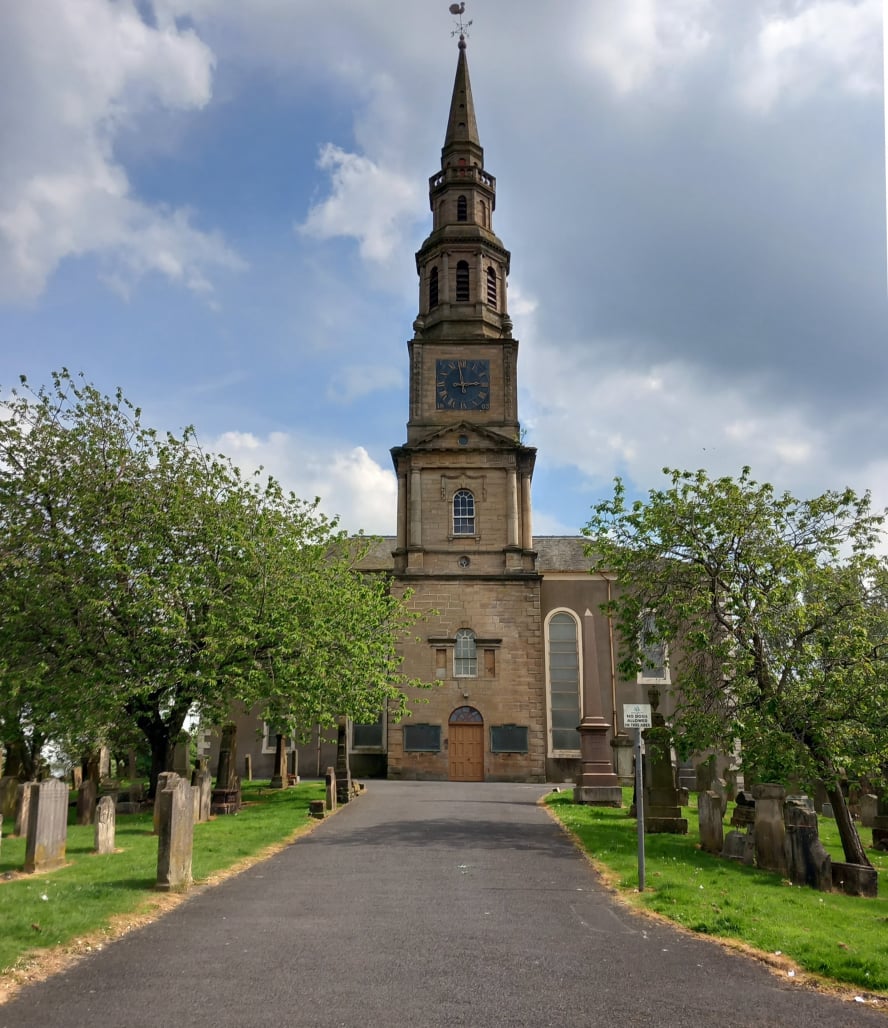
Irvine Burns Club @ Irvine Old Parish Church

- a 2026 Bicentenary Year project
Irvine Old Parish Church


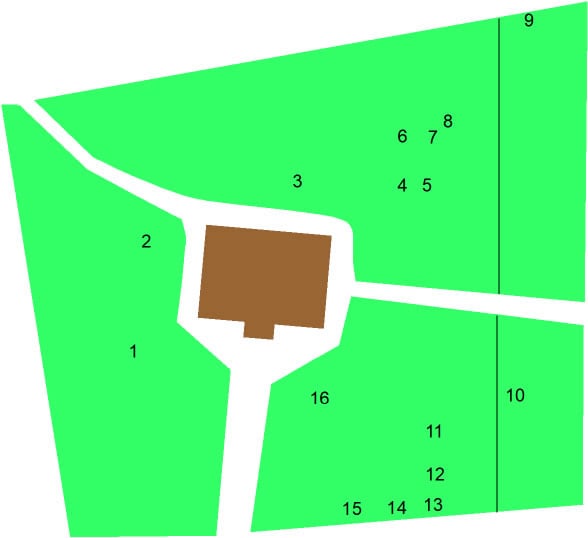
number 1 
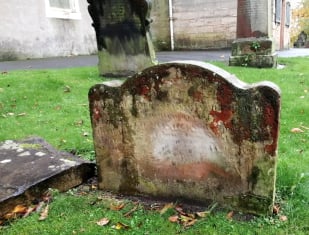
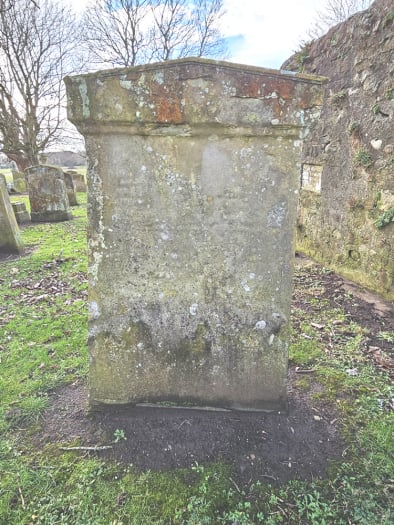
Starting from the main gate, walk up the path to its first left-hand bend and look past the larger monuments to the small stone with the curved top; the inscription faces away from you.

William Shields, senior (d.1843, aged 83)
The small stone, with a distinctive curved top, is that of founder member William Shields, a boot- and shoe-maker who lived on the High Street, owned a ship, and was known for his great strength. Back to top
William Shields


number 2
Walk to the left of the church, and to left of the side door, look to your front left and go to the impressive six-legged stone memorial

Helen Miller (c.1762-1827, aged 64)
One of the 'Mauchline Belles' ("Miss Miller is fine") immortalised by Burns in 1784-85, when she was aged 22. In 1791 she married John McKenzie, who, with friends in Irvine, founded Irvine Burns Club in 1826 and served as the first President of the Club. Read more . . or Back to top
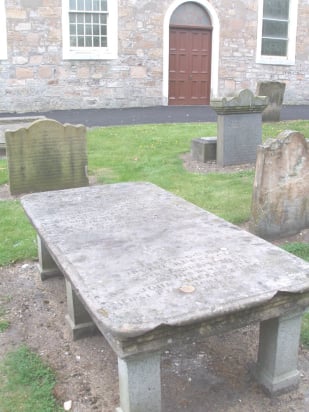
John Mackenzie MD


number 3
Now walk to the back door of the church, and look look front and right for a stone newer than its neighbours about seven steps from the edge of the path 

David Sillar, 'Dainty Davie' (1760-1830, in his 70th year)

Founder member David Sillar, a close friend of Burns from when they lived on adjacent farms near Tarbolton, was one year younger than the poet. Burns wrote two 'Epistles to Davie', kindly referring to him as 'a brother poet'. His gravestone was renewed in 1962.  Read more . . or Back to top
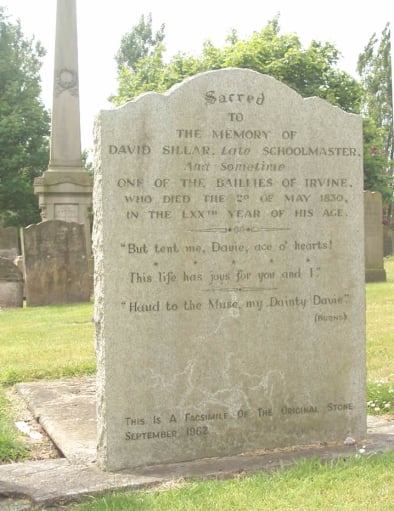
David Sillar


 number 4
Looking towards the river, go directly forwards to the obelisk with a wreath carved half way up it

William Gillies (1797-1841, aged 44)

This Irvine Burns Club founder member, William Gillies, a grain dealer, played a central role in the life of the Burgh and served as Provost in 1839-41. He was so popular that, as you can read on the inscription, this fine memorial was “erected by his townsmen”. Read more . . or Back to top

William Gillies


number 5
Now go directly behind the Gillies monument and stop in the next row, between, on your left, the grave of Christina Drennan Wilson and, on your right, the distinctive memorial to butcher John Thomson (with carvings of a meat cleaver and an axe). Between these two, you will see a flat stone

James Allan (d.1855)

Founder member James Allan was a grocer who lived on the High Street. A bachelor, he was assisted by his sister Jean and later by his nephew Joseph Gillies, recorded as a 'shop boy'.  Back to top
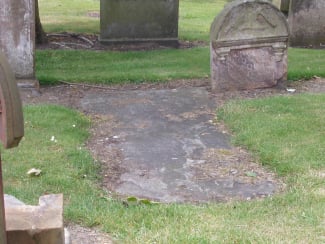
James Allan


  Before moving on, don't miss the neighbouring gravestone (here on the right of his grave) of John Thomson - on its front, the symbols of his trade as a flesher, that is, a butcher, and, on the reverse, the dramatic carving of the raising of the dead, announced by an angel with a trumpet.


number 6
Step back to the Gillies monument, and walk about 15 steps to the left. Directly in front of the fallen stone (of Rev Hugh Jaffrey) is an old flat slab

Dr Charles Fleeming 

In 1956, as pharmacist Charles Balcombe cleared his attic at 49 Kirkgate, he found an old ledger - the daybook of Dr Charles Fleeming, the doctor who attended Robert Burns in November 1781. The daybook records his visits and the potions he prescribed. His grave is the flat one in the photograph. Read more . . or Back to top
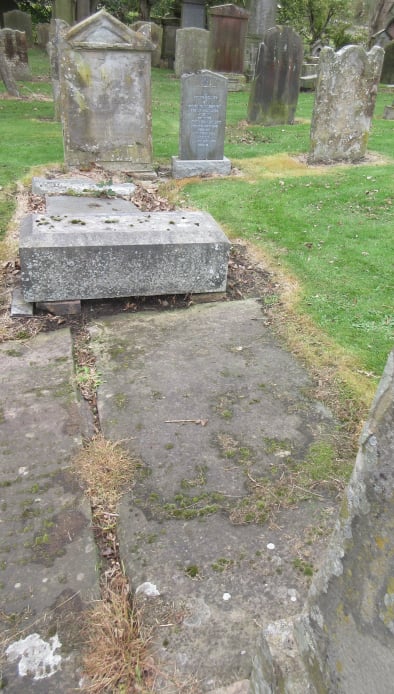
Dr Charles Fleming


number 7
Walk about five rows of graves towards the river and stop at a toppled gravestone

John Peebles (1798/9-1851) 

Founder member John Peebles was a tailor living on Bridgegate. His stone, upright until recent years, is now flat. A grim reminder of life in the 1800s is that five of his children died in infancy. He served as Convener of Trades 1822-1826. He joined Lodge Irvine St Andrew No.149 in 1818. Five of his children died in infancy. Listed in the Roll of Electors of 1833, he is not listed in Pigot's directory of 1837. Back to top
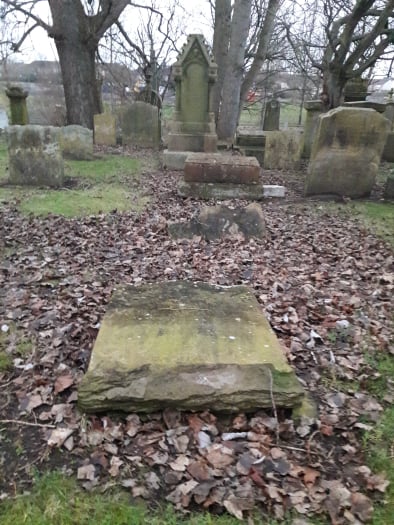
John Peebles


  Before moving on, look at the stone on the left and admire the carving on the back of it, showing an angel of heaven, and a skull and crossbones (what will remain of us!).
John Turner, a weaver in Irvine, was an ancestor of politician Tony Benn, whose maternal grandfather was born at Friarscroft Irvine to this weaver’s daughter Elizabeth and her husband James Holmes.


number 8
Walk one row nearer the river, and one stone left of that of John Peebles, to a very square memorial stone

John Spiers (1817-1899)
John Spiers left Irvine as a young man and enjoyed a long, successful and honourable career as an underwriter and insurance broker at Blythswood Sq., Glasgow. He donated the statue of Robert Burns to Irvine in 1896 - read about it on a separate page. This stone was erected by him in memory of his father, a cloth merchant, his mother and his sister. Back to top
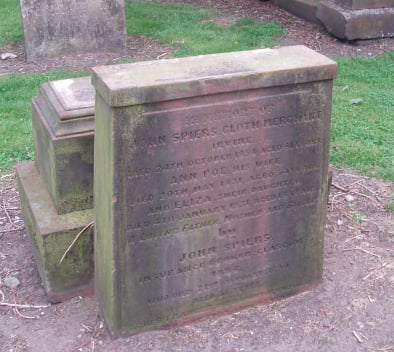
John Spiers


number 9
Go now to the high wall at far left, step over the low wall sub-dividing the graveyard, and stop at the third memorial, with its two panels, on your left

John Paterson (1827-1898)
John Paterson served as Provost of Irvine in 1872-1878. After his death, his widow and family built 'Wellwood'. When the last of the family died, they bequeathed 'Wellwood' to Irvine Burns Club which until then had enjoyed the use of a room in the home of the Hogg family after whom the Club library is named. Read more . . or Back to top
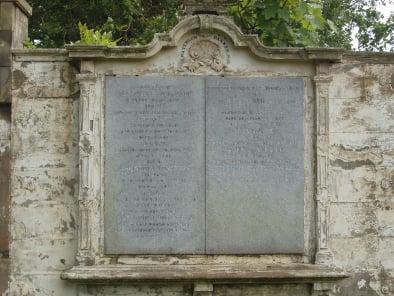
John Paterson


number 10
Return now to the nearest corner of the church, take a few steps forward and take the path on your left, going about half way down, as far as the low sub-dividing wall. Follow this low wall to your right as far as where there are two fallen stones, one on its face towards the church, but we visit the other one, on its back towards the river

James Johnston (1794-1853)

Founder member James Johnston, originally from Ayr, was the Town Clerk of Irvine, for 32 years from 1818 to 1853. He served Irvine Burns Club as President in 1833 and as Honorary Secretary for many years. One son, John, d. at Tacna, Peru, in 1859, age 33. Another died on his passage to Rangoon in 18?9. When he died in 1853 twelve days before the Annual Dinner, Irvine Burns Club cancelled the Dinner as a mark of respect, both to him after many years' service as Honorary Secretary of the Club, and also to other principal Club members who had also recently lost family members. Back to top
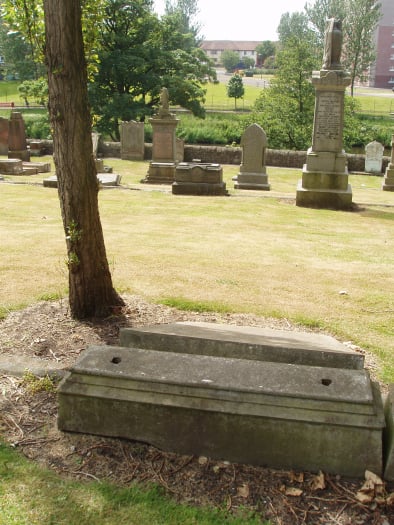
James Johnston


number 11
From where you are, look to the main gate and on that line of sight you will see an urn-topped column. Walk over to it

Robert Wyllie (1792/3-1843)

Founder member Robert Wyllie was Irvine Harbourmaster until his death in 1843 in Edinburgh, soon after giving evidence in the High Court on behalf of his friend James Beaumont Neilson, inventor of the 'Hot Blast' which revolutionised the iron industry - when rivals copied his system, Neilson went to court to defend his rights and Capt. Wyllie could testify to having seen his friend first apply his Hot Blast technique to fires or furnaces in Irvine. His appointment as Harbourmaster was very shortly before the foundation of the Club, possibly even only the previous day (June 1st). Back to top
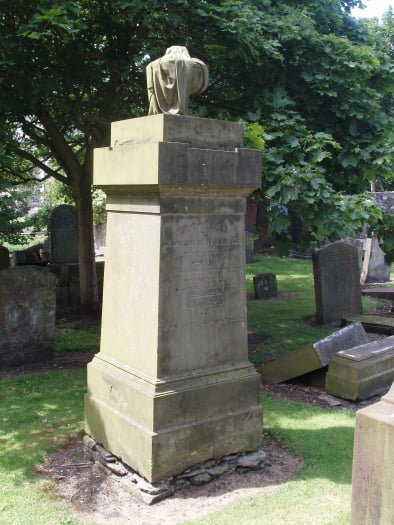
Robert Wyllie


number 12
Now go about five graves towards the wall, to a very rectangular stone

John Orr (1790/1-1864)
Founder member John Orr was a grocer and a linen & woollen draper at Halfway (the street to the 'Haven', later renamed Montgomery Street after James Montgomery, the 'Christian poet' born in Irvine). Married in 1821, his five children were baptised in the Irvine East Associate Church. The gravestone was erected by him in memory of three daughters and two sons. He is recorded to have been known to Robert Burns - though very young, he may have met the poet! Back to top
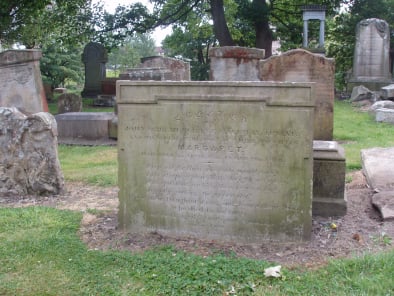
John Orr


number 13
Turn to face the wall where no memorials remain. Today there is no marker for our next individual, but he lies at the end of the same row as the previous stone, and there may have been a plaque on the wall

Rev. Alexander Campbell 
Alexander Campbell, the Irvine Burgher Kirk Minister (1809-43), inherited what may be the only surviving manuscripts of the Kilmarnock Edition, and in 1837 gave them to Patrick Blair, a founder member of Irvine Burns Club, for safekeeping by the Club. His church moved into the new Trinity Church in 1863. A link with the previous grave is that John Orr was a member of his church. The next grave is that of his nephew. Back to top
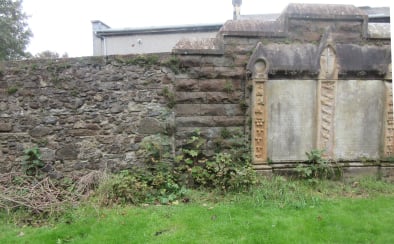
Rev. Campbell


number 14
Move slightly to your right to the two-section memorial

Patrick Blair (1795-1873)
Founder member Patrick Blair was a prominent 'writer' (solicitor) and Church member in Irvine. He was involved in many good causes, whether social, educational or religious, and donated the land for Trinity Church (opened 1863). Read more . . or Back to top
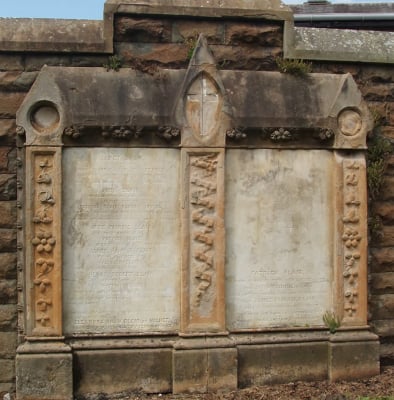
Patrick Blair


number 15
Now move to the right, just past where the wall line changes its course

Maxwell Dick (1797-1870)
Founder member Maxwell Dick was possibly Irvine's most influential 'mover and shaker' of the 1800s, with numerous interests. A bookseller, printer and publisher, he had links with well-known authors in London, was interested in any new inventions, and, with others, purchased the birthplace (since demolished) of 'the Christian poet', hymn-writer James Montgomery, in the Halfway. Read more . . or Back to top
Maxwell Dick


number 16
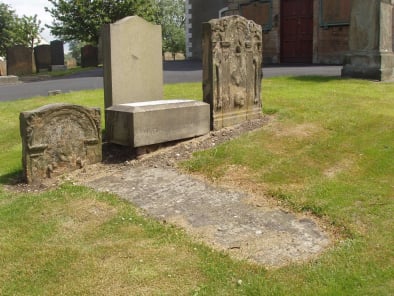
Walk across the grass towards the church and stop at a group of three stones, one very weather-worn with a grave slab in front of it

John Fletcher (1798-1830)
Founding member John Fletcher was a surgeon residing in the Parterre on the High Street, highly respected and successful, and a town councillor and baillie. Implicated, with others, later in 1826 as a resurrectionist (body snatcher), so socially ruined, he moved to Ayr and died, of paralysis, aged 32. Although sometimes referred to as having met the poet, he could not have done so, though his father William may have been a friend of Burns. In November, 1830, his body was interred in his parents' grave in Irvine Old Parish Churchyard. Back to top
John Fletcher


You have reached the end of the trail. Now visit www.irvineburnsclub.org

Extra notes on some of the individuals follow below.


#2 - Helen Miller, wife of Dr John McKenzie

This is the final resting-place of Helen Miller, immortalised by Burns as one of the 'Mauchline Belles', when she was 22:

In Mauchline there dwells six proper young belles,
The pride of the place and its neighbourhood a',
Their carriage and dress, a stranger would guess,
In Lon'on or Paris, they'd gotten it a'.
Miss Miller is fine, Miss Markland's divine,
Miss Smith she has wit, and Miss Betty is braw,
There's beauty and fortune to get with Miss Morton;
But Armour's the jewel for me o' them a'. 

In 1791, Helen Miller married Dr John McKenzie, the doctor who tended Burns’ father during his last illness in 1783/84. Dr McKenzie became a loyal friend to the family, particularly Robert, whom he described as "displaying a dexterity of reasoning, an ingenuity of reflection, and a familiarity with topics apparently beyond his reach".  In 1796, the new 12th Earl of Eglinton, one of his patients as Colonel Hugh Montgomerie at Coilsfield, persuaded him to move to Irvine, granting him the life rent of Seagate House on Eglinton Street. Dr McKenzie served on Irvine Town Council for 27 years - his Council chair is now the President's chair in Irvine Burns Club. In 1826, he gathered eleven other Irvine citizens to establish Irvine Burns Club and served as the Club's first President. His wife Helen died in 1827, aged 64, and Dr McKenzie, widowed, retired to Edinburgh - he died there in 1837, and is buried in New Calton Cemetery. Irvine Burns Club restored his wife's gravestone in 1922. 
Now walk round to the back of the church.


#3 - David Sillar, 'Dainty Davie'

Proceeding round to the back of the church, near its back door, look to your front left for the grave of David Sillar, the boyhood friend of Burns, one year younger than the poet. Sillar followed Burns in publishing his poetry, doing so three years later, but with less success. Burns wrote two Epistles to Davie, kindly referring to him as 'a brother poet', and greatly admired his fiddle-playing, leading to immortalising him as 'Dainty Davie' in the last verse of the Second Epistle: 
 "Haud to the Muse, my dainty Davie:
The warl' may play you monie a shavie,
But for the Muse, she'll never leave ye,
Tho e'er sae puir;
Na, even tho limpin wi' the spavie
Frae door to door."
Robert Burns was right that Sillar would have a mixture of ill fortune and good fortune in his life. Sillar moved to Irvine in about 1783 as a grocer, joined the Town Council, and was a founder and the first Vice-President of Irvine Burns Club. His Council chair is now the Vice-President's chair in Irvine Burns Club. At one stage, he ran a school of navigation, this probably being the start of his friendship with Fife-born Royal Marine, and poet, Captain Charles Gray, which in turn led to strong links between Irvine Burns Club and the poets in the Edinburgh literary world of the 1830s.
David Sillar died in 1830, in his 70th year, his last illness preventing him serving as Irvine Burns Club President, though his son Zachariah did serve as President a few years later. His gravestone was renewed with this facsimile stone in 1962.
Now make your way to the tall pillar in front of you, with a wreath carved near the top.

#4 - William Gillies, grain dealer

This imposing column marks the grave of grain dealer William Gillies, a founder member of the Irvine Burns Club. In 1830, he was appointed manager of the new Irvine branch of the Ayrshire Banking Company. From 1833, he also played a central role in the life of the Burgh, and, while serving as Provost in 1839, he chaired the banquet hosted by the Earl of Eglinton after his famous Tournament – the last such medieval pageant to be held in Britain. William Gillies was so popular that, as you can read on the inscription, this fine memorial was “erected by his townsmen”. Born in 1797, he died in 1841, at the age of 44. A few years later, his daughters ran a successful educational institute for young ladies at 79 High Street.

#6 - Charles Fleeming

In 1956, as pharmacist Charles Balcombe cleared his attic at 40 Kirkgate, he found an old ledger - the daybook of Surgeon Charles Fleeming (the 18th century version of Fleming), the doctor who treated Burns in November 1781. The daybook records the potions he prescribed - an anodyne painkiller (probably opium), quinine to reduce fever, an emetic and a laxative - though we don't know what he thought the illness was.
Doctors in those days would be asked, as still happens today, to recommend a branded product and in the 1782 newspaper the 'Glasgow Mercury' appeared an advert for Maredant's Drops, as recommended by Mr Charles Fleeming, Surgeon in Irvine, for successful treatment of old obstinate leg ulcers.

#9 - John Paterson

The left-hand panel records Alexander Paterson and his family. For 50 years a banker in Irvine, he died in 1867 (“in his 82nd year”), after his daughter Mary (aged 16), his son Robert, a merchant in Montreal (aged 30), his son James (aged 36), his spouse Christina (aged 68) and his daughter Grace (aged 39). The right-hand panel commemorates Alexander’s third son John Paterson (1822-1898) of Knowhead (near Muirkirk), who followed his father as a banker in Irvine and served as Provost of the Royal Burgh from 1872 to 1878; the panel also names his eldest son, his third son and his wife. John Paterson’s last surviving sons, James and Robert, having no families, bequeathed their home of ‘Wellwood’ to Irvine Burns Club.

#14 - Patrick Blair

Patrick Blair (1795-1873), a founder member, was a prominent 'writer' (the term for a solicitor in Scotland) and Church member in Irvine, involved in many good causes, social, educational or religious. He lived on the High St (opposite today's Townhead Surgery). Having commenced as a solicitor in 1818 he became the senior partner of Blair & Highet, Solicitors, Irvine, his clients including Irvine individuals claiming compensation for the loss of slave labour in the West Indies. He was the Irvine agent for the Western Bank and, after its 1857 collapse, for the Clydesdale Bank, he became Deputy-Governor of the Irvine Savings Bank. He also served as a JP Clerk for the Irvine district. A devoted church member, he often represented both the Royal Burgh and the Presbytery of Irvine at the General Assembly. He was involved in may good causes, whether social, educational or religious. He was an administrator of the funds of Lyle's Free School, established by the Free Church in 1839 to provide free education for poor children of that district. He donated the land for Trinity Church (opened 1863). He arranged for the removal of a minister's plaque (Rev. Alexander Campbell, minister of the Burgher Kirk 1809-1843), to make way for his own memorial in the graveyard. He and his wife John (sic) Fairrie had at least ten children. The first name on the memorial is Janet Shaw, his mother, whose sister Eleonora was the wife of Rev. Campbell.  

#15 - Maxwell Dick

Maxwell Dick (1797-1870), a founder member, was possibly Irvine's most influential 'mover and shaker' of the 1800s, with numerous interests. A bookseller, printer and publisher, he had links with well-known authors in London, was interested in many new inventions, and twice served as President of Irvine Burns Club. After running a successful printing business in Paisley, he opened a bookshop on Irvine High Street, then acquired Macquiston's business in 1820. One of the Macmillan Publishing founder brothers (Daniel) worked in his shop for seven years as a teenager. He produced an Irvine News-Letter which was published for several years and, from 1858, an Ayrshire News-Letter. He devised a snow plough in 1827, experimented with a suspension railway at Gailes in 1829, invented a water-warmed bed for cholera patients in 1832, and was experimenting with guano and artificial fertilisers in 1856. His friend James Steadman was one of several around the world who have a claim to the invention of the screw propeller. On the Town Council he served as Dean of Guild and as a Magistrate and was a councillor for almost 50 years. When the New Hall was begun next to Burns Cottage, he laid the Foundation Stone on behalf of Freemasons. He served twice as President of Irvine Burns Club, in 1835 and in 1854, and, as a lithographer, produced facsimiles of some of the manuscripts held by the Club. His printing business passed to Charles Murchland.