Wellwood, our home

Take this online tour of the house (courtesy of North Ayrshire Council), and read below about the family who bequeathed their Edwardian home to Irvine Burns Club

Wellwood

In 1904, the widow and family of John Paterson (who had bought an Eglinton St house in 1869) bought the property next to it to build the 5-bedroom 'Wellwood', possibly because one of the family (Thomas, see 'family' below) was retiring from Canada and returning to Scotland in 1905. Shown here in the watercolour [Wellwood Collection #3075] by Past President Jim Butler, it is named from Wellwood, near Muirkirk, where John's grandfather had farmed and died.

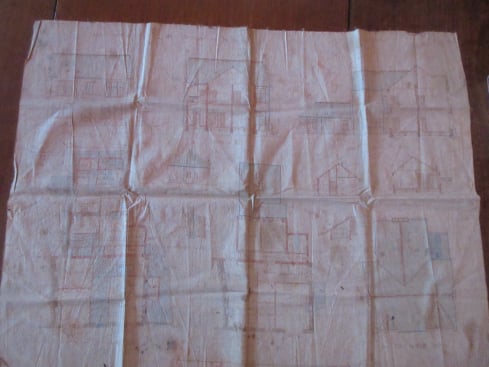
Wellwood plan 1904

We possess the original linen plan drawn up by Irvine architects J & J Armour in 1904. On the ground floor: Entering the hall, on the left was the parlour (now the Directors' Room) and a bedroom (now the Hogg Room library), and on the right the dining room (now the Burns Room). Further back, through the door, were, on left a closet (now the gents' WC) and a servants' room (now a kitchen) and on right a kitchen (now Ladies' WC and the Templeton Chair area). To the rear of the building were also a scullery, a larder, a wash-house, a store, a coal cellar, a WC and a toolshed.

Music room

On the upper floor: On left was the drawing room with its bow window, a box room (where the Burns window panels are now) and, on right a front bedroom, these three now being one as the Music Room (pictured here). Opposite the stair was a bedroom (now storeroom). To the right were a closet (now fire escape), two rear bedrooms (now together as the Wilson Room), a WC (still one!) and a bathroom (now a kitchen).

In the Directors' Room are the chairs occupied by Club founder members Dr John Mackenzie and David Sillar when councillors of Irvine Burgh Council; the Council presented the chairs to the Club in 1926 in recognition of the Club’s centenary; at Directors' meetings they are occupied by the current President and Vice-President.

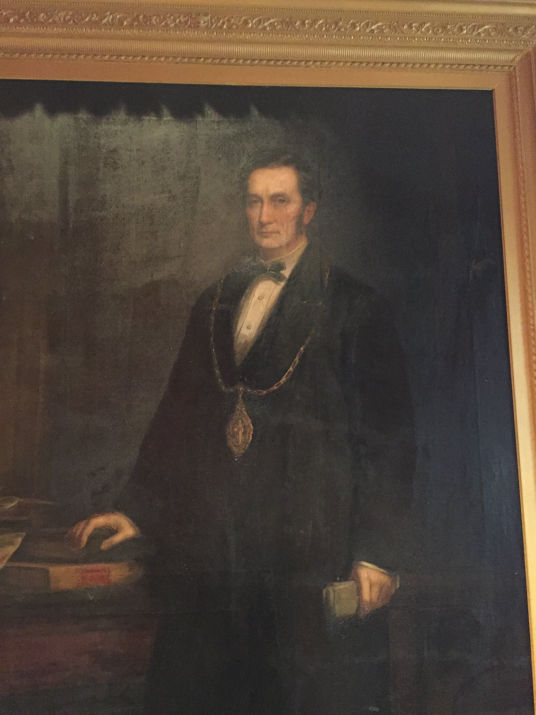
John Paterson

John Paterson (1827, in Irvine - 1898, at the Union Bank House, Irvine), the son of Alexander Paterson, Union Bank agent and J.P. in Irvine, followed his father as a bank agent. He was a Burgh councillor for many years, and Provost 1872-78. This 1877 portrait, now in 'Wellwood', recognised "his valuable public services during a period of 23 years". John Paterson was also a keen local historian, and his information about the development of Irvine harbour is published online at www.irvineharbourside.org

The portrait title states "of Knowhead" - we do not know which Knowhead - Knowehead 3.5m NE of Irvine OR Knowhead, a farm near Wellwood, near Muirkirk (in this Knowhead in 1841 lived members of the Lapraik family related to the John Lapraik to whom Burns wrote two Epistles in 1785. See more about the Lapraiks on another page.)

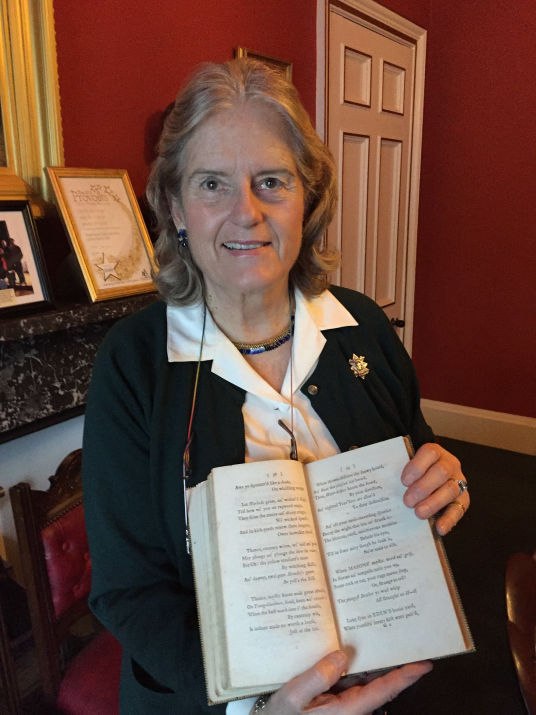
Elspeth Straker

Elspeth Straker, a great-great-grand-niece of John Paterson, holding the first (Kilmarnock) Edition of Burns' works in 'Wellwood' in January 2017, on the 50th anniversary of the opening of the Wellwood Burns Museum.

Scroll down for more about the Paterson family, and their generous bequest to Irvine Burns Club. Irvine Burns Club used the ground floor from 1963, and became the sole occupant in 1976.

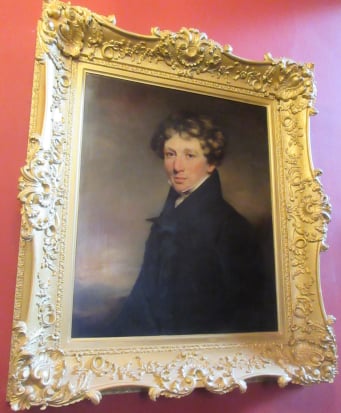
William Young


This painting probably shows Wm Young, an uncle of John Paterson - he was a SSC (solicitor) in Edinburgh and died young in 1816. James G Paterson, who died in 1952, wrote that he had an oil painting of Wm Young, and we believe this to be it. It graces the hallway of 'Wellwood' and incoming Presidents have often been photographed with him in the background.

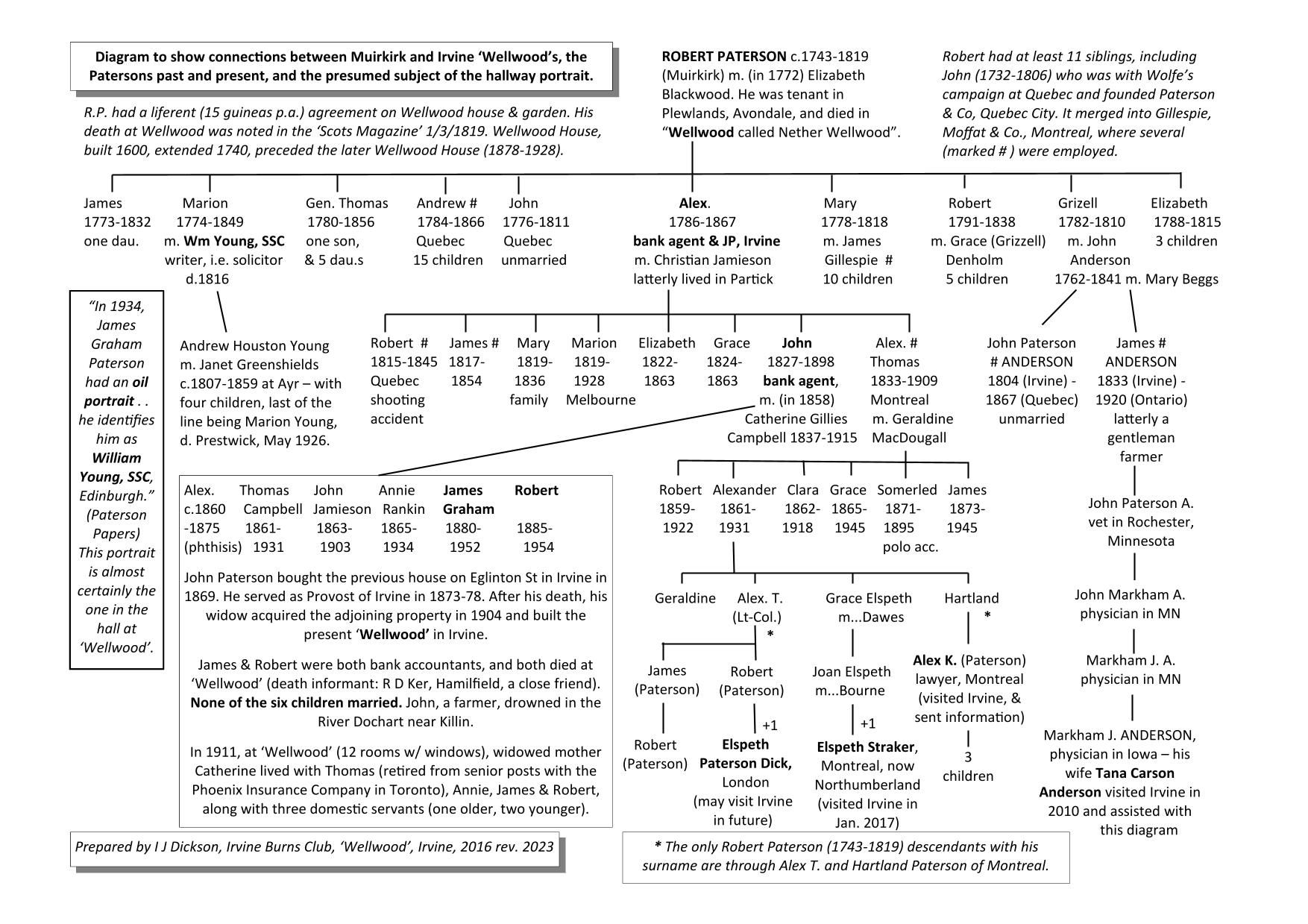
John Paterson's family:
       (see family tree chart below)
John Paterson and Catherine Gillies Campbell married in 1858 and had six children, none of whom married. Alex died of phthisis (TB) in 1875, aged 15. John, a farmer, drowned in the River Dochart in 1903. Four lived with their widowed mother in 'Wellwood', with (in 1911) three domestic servants. Their mother died in 1915, aged 77. Thomas, once Chief Inspector of the Phoenix Insurance Coy in Toronto, later Manager of its office at Toronto, retired to Scotland in 1905 and died in 1931, aged 69. Annie died in 1934, also aged 69. James (d. 1952, aged 71) and Robert (d. 1954, also aged 69), both bank accountants, bequeathed the house to Irvine Burns Club, subject to the condition that the Club looked after the interests of their housekeeper Miss McLean (dates of transfer below).

John Paterson's siblings (with reference to 'Wellwood'):

John's three brothers all emigrated to a family business in Montreal*. One was Alex. (1833-1909), and three of his descendants have visited 'Wellwood'. 
A great-grandson, James, visited the two Paterson brothers in Irvine in the 1940s and returned to 'Wellwood' on their death (1954). Another great-grandson, Alex. K Paterson#, an eminent Montreal lawyer, has visited the Museum.
A great-great-granddaughter, Elspeth#, visited from Northumbria in 2017, and another great-great-granddaughter, also named Elspeth, of London, had hoped to visit.
* John's great-uncle John (1732-1806) had been with Wolfe's campaign at Quebec and had founded Paterson & Co in Quebec City.
(# these two have both contributed to our information)

John Paterson's wider family
(with reference to 'Wellwood'):

John's grandfather Robert, a tenant farmer, died at Wellwood House, Parish of Muirkirk, in 1819, aged 76.
Of his ten children, one was John's father Alex., agent for the Ayr Bank, then for the Union Bank. Another was Marion - she married the Edinburgh 'writer' (i.e. solicitor) William Young who died young in 1816 and whom we believe to be the subject of the portrait in the 'Wellwood' hall (Paterson papers record James G Paterson having an oil portrait of him). Another was Grizell, whose early-widowed husband's great-great-great-granddaughter Tana in Iowa has also kindly contributed to our information and visited Irvine in 2010.

Return to top of page

Paterson Family

John Paterson's father, Alexander, took charge of the Irvine branch of the Ayr banking firm Hunters & Co in 1817, absorbed by the Union Bank of Scotland in 1843. Needing new premises, he was authorised to purchase and demolish 167 & 169 High St to make way for a bank office and a large agent's house.

John Galt, born in the middle flat of no.169, was commemorated by a black marble mantelpiece in the new bank office. At demolition c. 1969, the mantelpiece could not be kept. The bronze Galt plaque of 1903 was saved for re-erection on the present building by banker Jim Wales (Irvine Burns Club President in 1972).

John Paterson arranged to build a family home. Completed before 1904, it was named 'Wellwood' after the house, near Muirkirk, where John's grandfather Robert had lived. In 1924, his son Graham was not appointed bank manager, so did not have to move into the bank house, and 'Wellwood' remained with the Paterson family.  

Dates in the 'Wellwood' background (information from the title deeds, via Robin Whyte)

1869 - John Paterson, banker, Irvine, buys the house then existing on the site at a public roup from the Trustees of Thomas Campbell of Killyleoch (a farm near Dumfries), then residing at Annfield, Irvine (Thomas Campbell was Provost 1851-64)
1898 - John Paterson dies and the house passes to his widow Mrs Catherine Gillies Paterson.
1904 - Mrs Catherine Gillies Paterson acquires the adjoining property to the north which belonged at one time to George Dickie, innkeeper, Irvine. It was possibly at this time that the family built the current (larger) house (at a cost of £2,000, then a significant figure).
1906 - Mrs Paterson conveys both properties to her daughter Miss Annie Rankin Paterson "For love, favour and affection".
1933 - Miss Paterson acquires the ground at rear of 'Wellwood', bounded by East Road, from the Trustees of David Martin, mason, formerly of Cotton Row and latterly 85 East Road, Irvine.
1934 - Miss Paterson dies, leaving her estate to her three brothers, Thomas Campbell Paterson, who predeceased (1931), James Graham Paterson and Robert Paterson.
1955 - The survivor of James and Robert dies (Robert, 1954) and by their mutual Trust Disposition and settlement, 'Wellwood' is bequeathed to Irvine Burns Club, subject to a liferent in favour of their housekeeper Miss Jessie McLean, later restricted to the upper flat.

1962 - Miss McLean leaves 'Wellwood'.
1964 - 'Wellwood' is conveyed to Irvine Burns Club subject to Miss McLean's liferent.

1967 - 'Wellwood' was opened as the home of Irvine Burns Club by Sam K Gaw, the 141st President
(1975 - On the demise of Irvine Royal Burgh, 'Wellwood' hosted the Royal Burgh of Irvine Museum; moveable artefacts have since been transferred to the care of the North Ayrshire Museums Service.)
1976 - Miss McLean renounces her liferent, leaving Irvine Burns Club as sole occupants of 'Wellwood'.

Burns Room on Bank Street

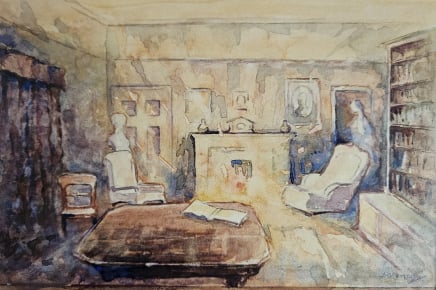
The Burns Club Room in the Hogg home at 21 Bank Street, Irvine

Before having occupancy of 'Wellwood', the Club had the use of a room in the home of the Hogg family, painted here by John M ('Jack') Ramsay, Club President in 1962. The 'Wellwood' library is named after the Hogg family.

The Hogg family were two brothers and a sister. Robert M Hogg had been Headmaster of Bank St. School, a Provost of the Royal Burgh (1923-28), and a highly respected Honorary Secretary of the Club from 1918 to his death in 1930. He was succeeded as Secretary by his brother James, also of the teaching profession, from 1931 to his death in 1936. Miss Margaret Hogg then cared for her late brother Robert's collection of books (now forming the basis of the 'Wellwood' library) and the Club recognised her long service by conferring Honorary Membership on her in 1960 - the first lady to be so honoured. On her death in 1961, it was revealed that the Hogg family had bequeathed the house to the Club; but since the Club had also inherited 'Wellwood', and needed finance to develop that property into a museum, the Club decided to sell the Bank St. house.

Jack Ramsay, in painting the picture, recalled that "The room was always aglow with warmth, radiating welcome from the open hearth, so generously stoked by Miss Hogg - for the room and its upkeep was provided free of any charge to the Club.